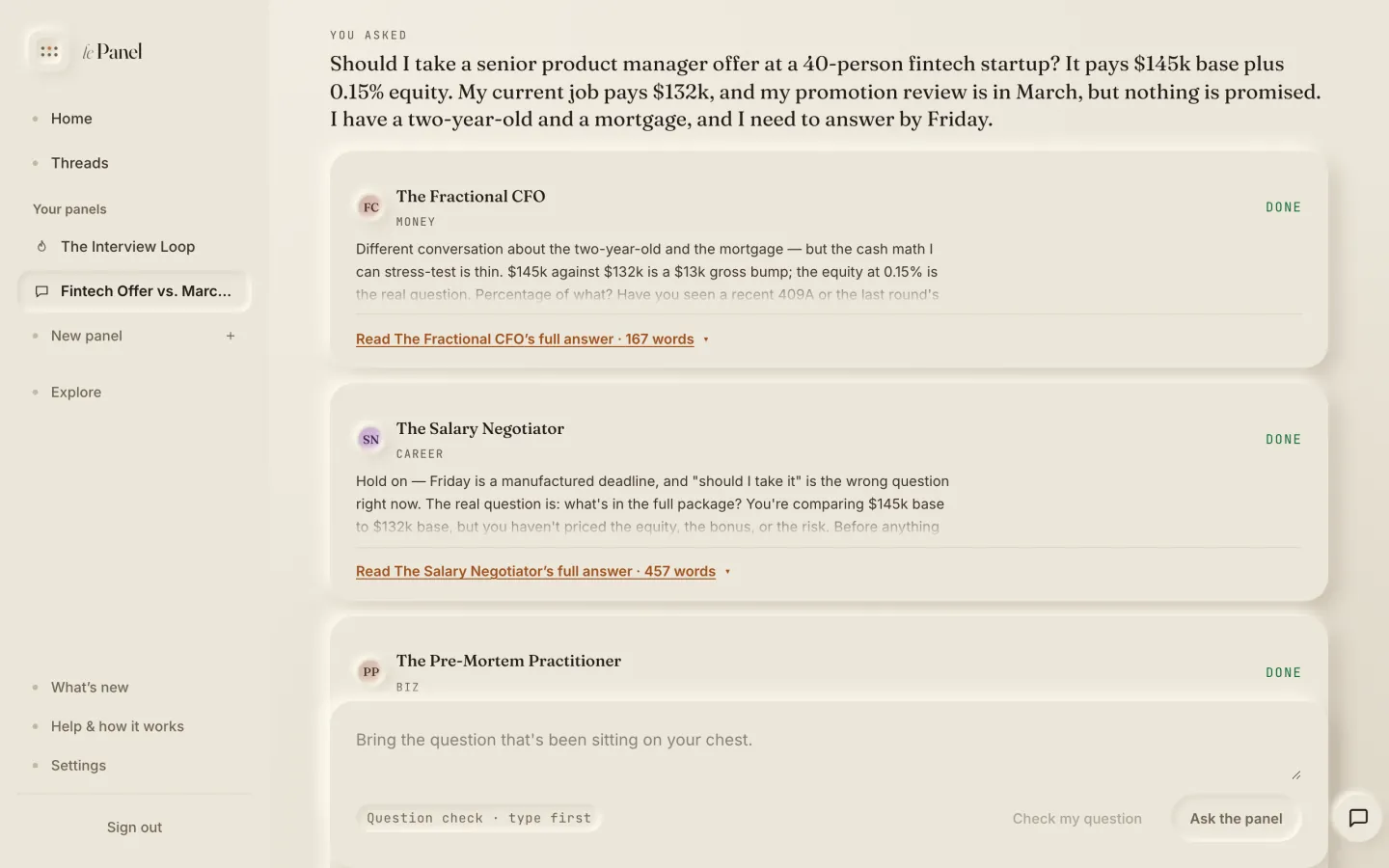
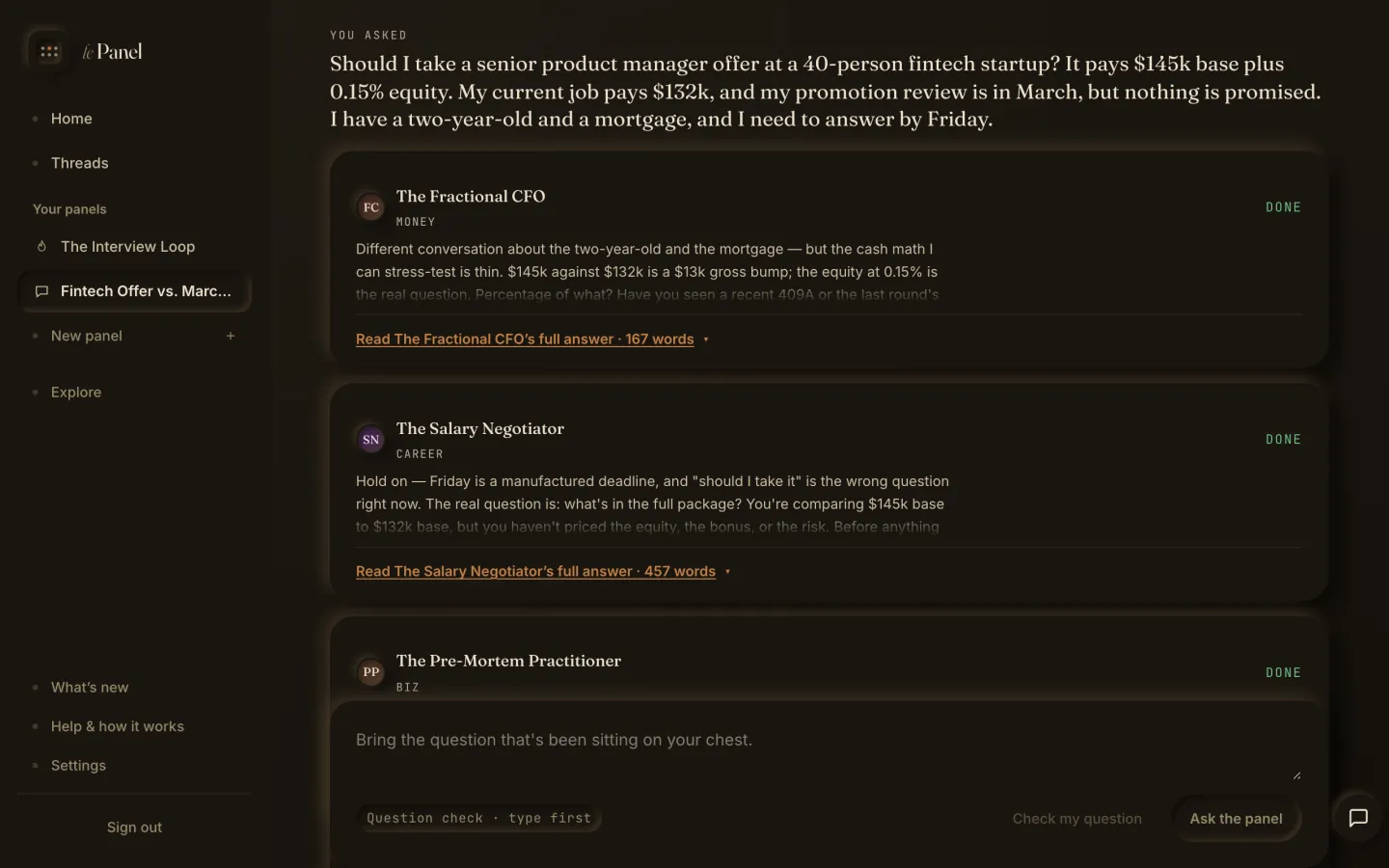
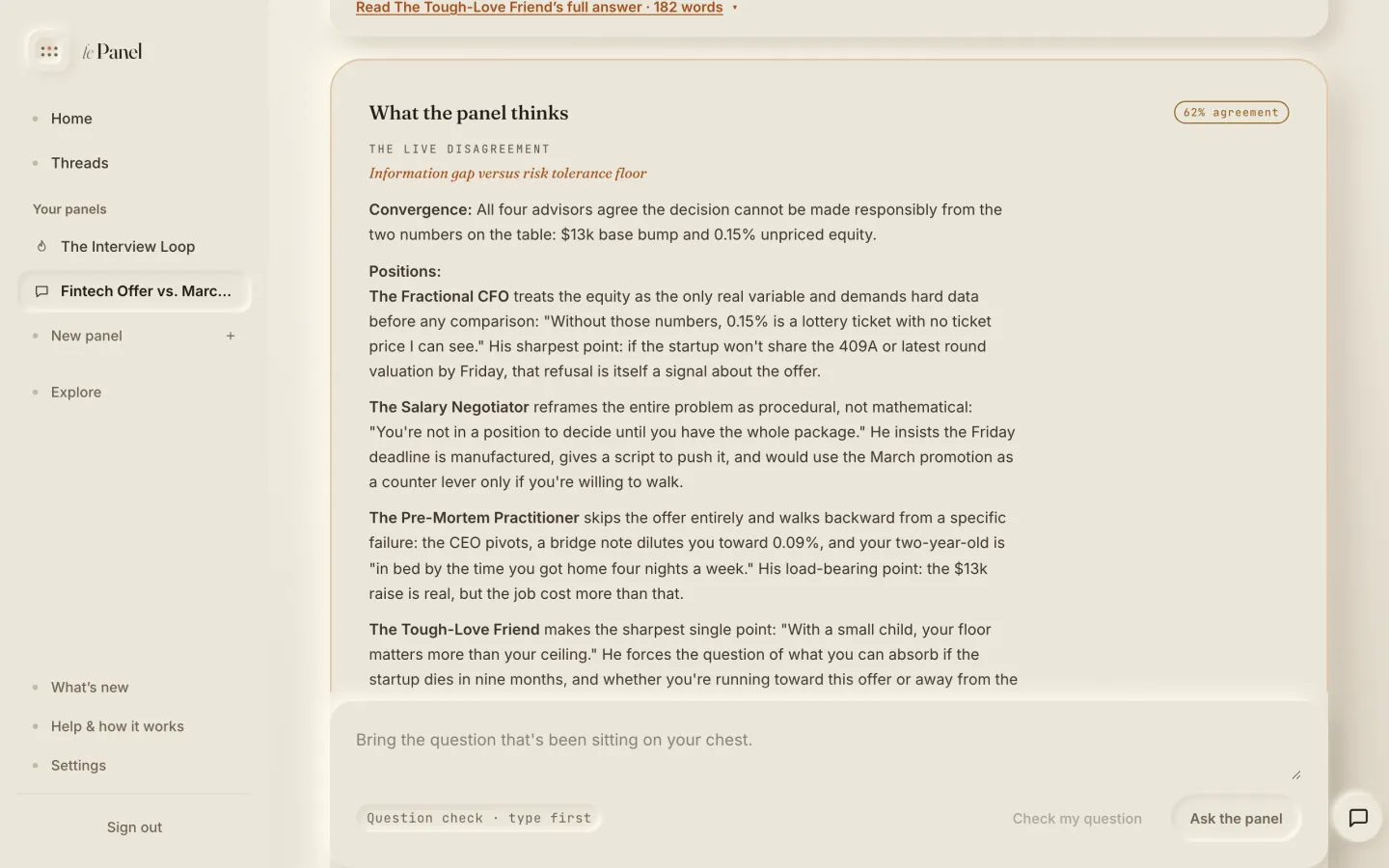
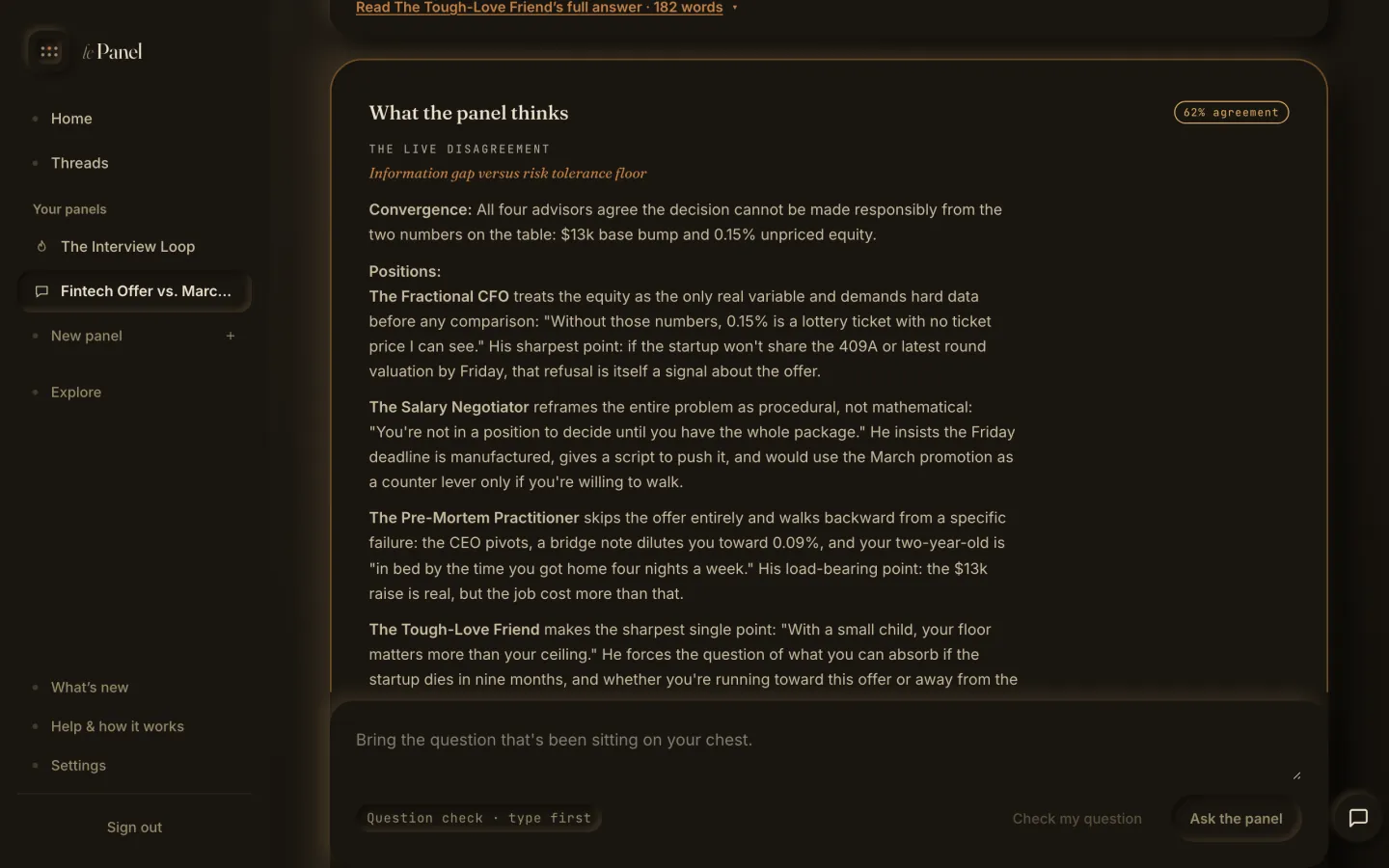
lePanel convenes a handful of advisors who answer a question from different angles, then reconcile the tension into something you can actually act on. Here’s the shape of it.
A round, start to finish
One real question, five moves: sharpen, charter, diverge, converge, mark. Step through it, or just watch it run.
1Sharpen
What you typed
“Should I quit my job?”
too vagueno contextmissing stakes
The panel’s sharpening
“I'm 38. I do alright, but I dread Mondays. Chase the promotion, or leave and build the thing I actually care about?”
Now the panel has stakes, constraints, and the real question behind the question.
2Charter
The panel’s charter
Pressure-test the big career move: evidence, taste, and the ten-year view. Not day-to-day execution.
On charter ✓
Every question is checked against the charter first. Off-charter asks get stopped here, so the room stays on-purpose.
3Diverge
Each advisor answers alone, in character. None of them sees the others.
VF
The Veteran Founder
Startups
Done
Dreading Mondays at 38 isn't a mood, it's a structural signal. The promotion won't fix it.
Dreading Mondays at 38 isn't a mood, it's a structural signal, and structural problems don't respond to title changes. The promotion moves you up the same structure that's producing the dread. So get diagnostic before you decide: which part of the week do you actually dread? The work, the people, or who you're becoming there? Leaving might fix those. But only if you know what you're walking toward.
CC
The Career Coach
Careers
Done
Write the founder sentence: building what, for whom. Can't? Then it isn't ready to plan yet.
You're allowed to want out, and the promotion won't quiet that; it's the same job with better furniture. But wanting out isn't a plan. Before you touch your notice, write the founder sentence: I'm building ___, for ___, because ___.
Blanks fill fast? You've been ready a while. Start scoping runway.
They don't? Keep the salary and spend ninety evenings filling them.
AR
The Aristotelian
Philosophy
Done
Don't ask which direction. Ask what kind of person each path makes you over ten years.
You're asking which direction; I'd ask a prior question: what kind of person does each path make you over ten years? We become what we repeatedly do, and the promotion is more of the same doing. Ten more years of dreaded Mondays is practice at overriding your own judgment. Neither path is safe. Choose the one whose daily habits you'd be proud to have become.
4Converge
Where the panel landed
35% agreement
The live disagreement
Specificity-first vs depth-first
All three agree on the diagnosis: the dread is real, and the promotion won't fix it. It promotes you inside the structure producing it. They split on the first move. The Career Coach wants specificity now: write the founder sentence and let the blanks decide. The Aristotelian wants depth first: settle who each path makes you before optimising the next step. The Veteran Founder sits between: name what exactly you dread, then choose.
Disagreement this sharp is the signal: weigh the specificity-first read against the depth-first one before you decide.
5Mark
Mark the round
Marking answers is how the panel learns your taste: which advisors it leans on next time.
What you typed
“Should I quit my job?”
too vagueno contextmissing stakes
The panel’s sharpening
“I'm 38. I do alright, but I dread Mondays. Chase the promotion, or leave and build the thing I actually care about?”
Now the panel has stakes, constraints, and the real question behind the question.
You choose what goes to the room: your version, the sharper one, or a blend.
The panel’s charter
Pressure-test the big career move: evidence, taste, and the ten-year view. Not day-to-day execution.
On charter ✓
Every question is checked against the charter first. Off-charter asks get stopped here, so the room stays on-purpose.
Each advisor answers alone, in character. None of them sees the others.
VF
The Veteran Founder
Startups
Idle
CC
The Career Coach
Careers
Idle
AR
The Aristotelian
Philosophy
Idle
VF
The Veteran Founder
Startups
Done
CC
The Career Coach
Careers
Done
AR
The Aristotelian
Philosophy
Done
Where the panel landed
35% agreement
The live disagreement
Specificity-first vs depth-first
All three agree on the diagnosis: the dread is real, and the promotion won't fix it. It promotes you inside the structure producing it. They split on the first move. The Career Coach wants specificity now: write the founder sentence and let the blanks decide. The Aristotelian wants depth first: settle who each path makes you before optimising the next step. The Veteran Founder sits between: name what exactly you dread, then choose.
Disagreement this sharp is the signal: weigh the specificity-first read against the depth-first one before you decide.
Mark the round
Marking answers is how the panel learns your taste: which advisors it leans on next time.
Each advisor answers alone, in character. None of them sees the others.
VF
The Veteran Founder
Startups
Done
Dreading Mondays at 38 isn't a mood, it's a structural signal. The promotion won't fix it.
Dreading Mondays at 38 isn't a mood, it's a structural signal, and structural problems don't respond to title changes. The promotion moves you up the same structure that's producing the dread. So get diagnostic before you decide: which part of the week do you actually dread? The work, the people, or who you're becoming there? Leaving might fix those. But only if you know what you're walking toward.
CC
The Career Coach
Careers
Done
Write the founder sentence: building what, for whom. Can't? Then it isn't ready to plan yet.
You're allowed to want out, and the promotion won't quiet that; it's the same job with better furniture. But wanting out isn't a plan. Before you touch your notice, write the founder sentence: I'm building ___, for ___, because ___.
Blanks fill fast? You've been ready a while. Start scoping runway.
They don't? Keep the salary and spend ninety evenings filling them.
AR
The Aristotelian
Philosophy
Done
Don't ask which direction. Ask what kind of person each path makes you over ten years.
You're asking which direction; I'd ask a prior question: what kind of person does each path make you over ten years? We become what we repeatedly do, and the promotion is more of the same doing. Ten more years of dreaded Mondays is practice at overriding your own judgment. Neither path is safe. Choose the one whose daily habits you'd be proud to have become.
The advisors in that round come from a public catalogue, no account needed: Browse all 270 advisors →
When they disagree, they debate it
They each answered without seeing the others. Have them respond to each other once, and the read updates to account for the argument.
The receipt: advisors reply to each other’s answers, disagreement named — on the record.How the debate runs
It runs when you ask for it, not automatically: once the answers and the read are on screen, the round offers a Have them debate button. The advisors that answered read each other’s answers and reply once — each naming where they push back and where they agree — and then the read is rewritten to account for the argument. The replies stay on the round as its transcript, above the read, so what you end up with is the disagreement named and kept, not smoothed into a consensus you can’t audit. One debate per round.
A grill, start to finish
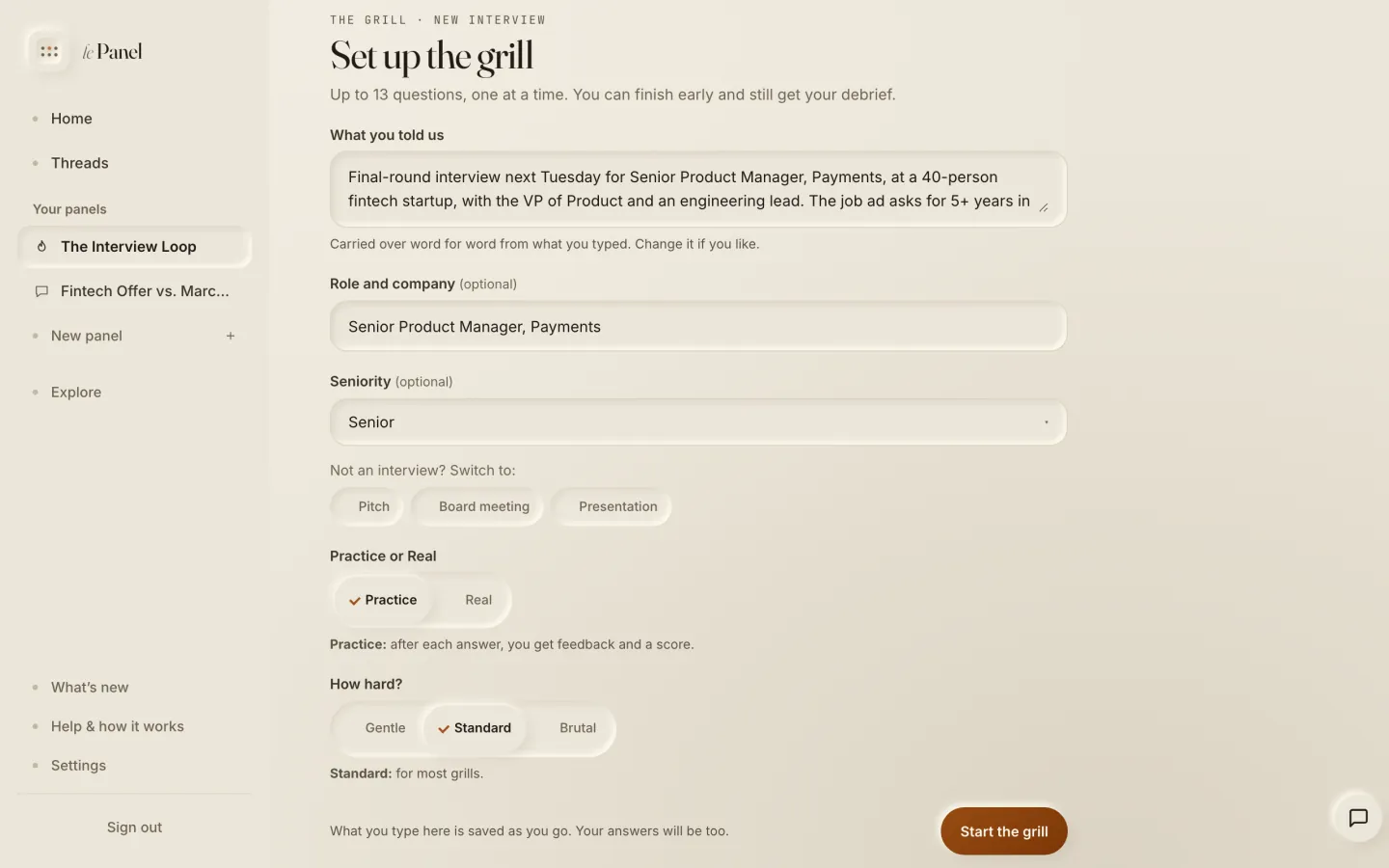
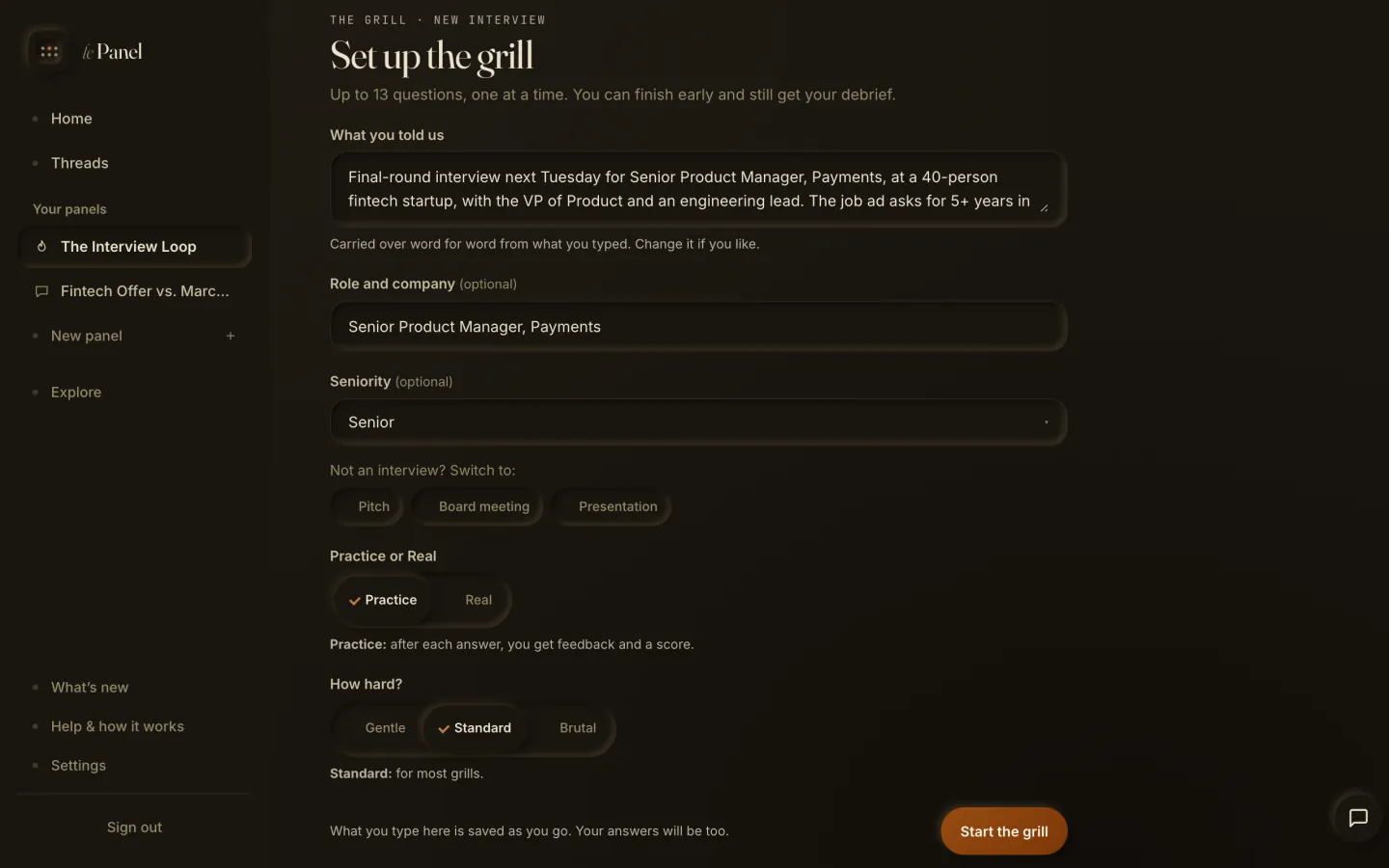
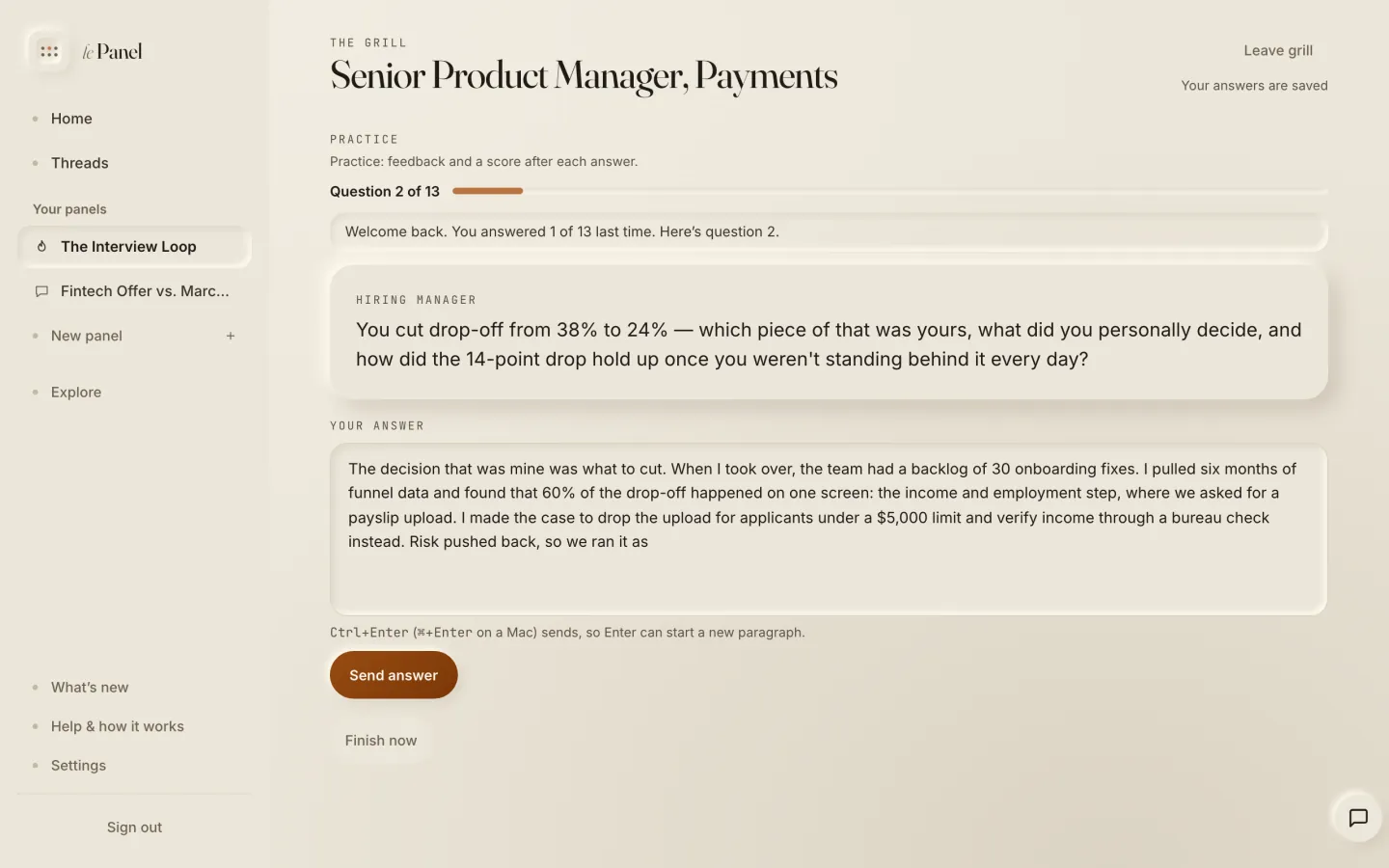
The same panel, pointed the other way: they ask, you answer, they score. Seven steps, from picking the room to the debrief.
1Interview, pitch, board, presentation
Picking the room: interview, pitch, board and presentation grills open.
2Tell the room what you’re walking into
The setup takes your role and the situation, so the questions are about your interview and not a generic one.
3Attach the JD, the deck, your notes
Attach what the room should read — a JD, a deck, your notes. Every question and every score is graded against it.
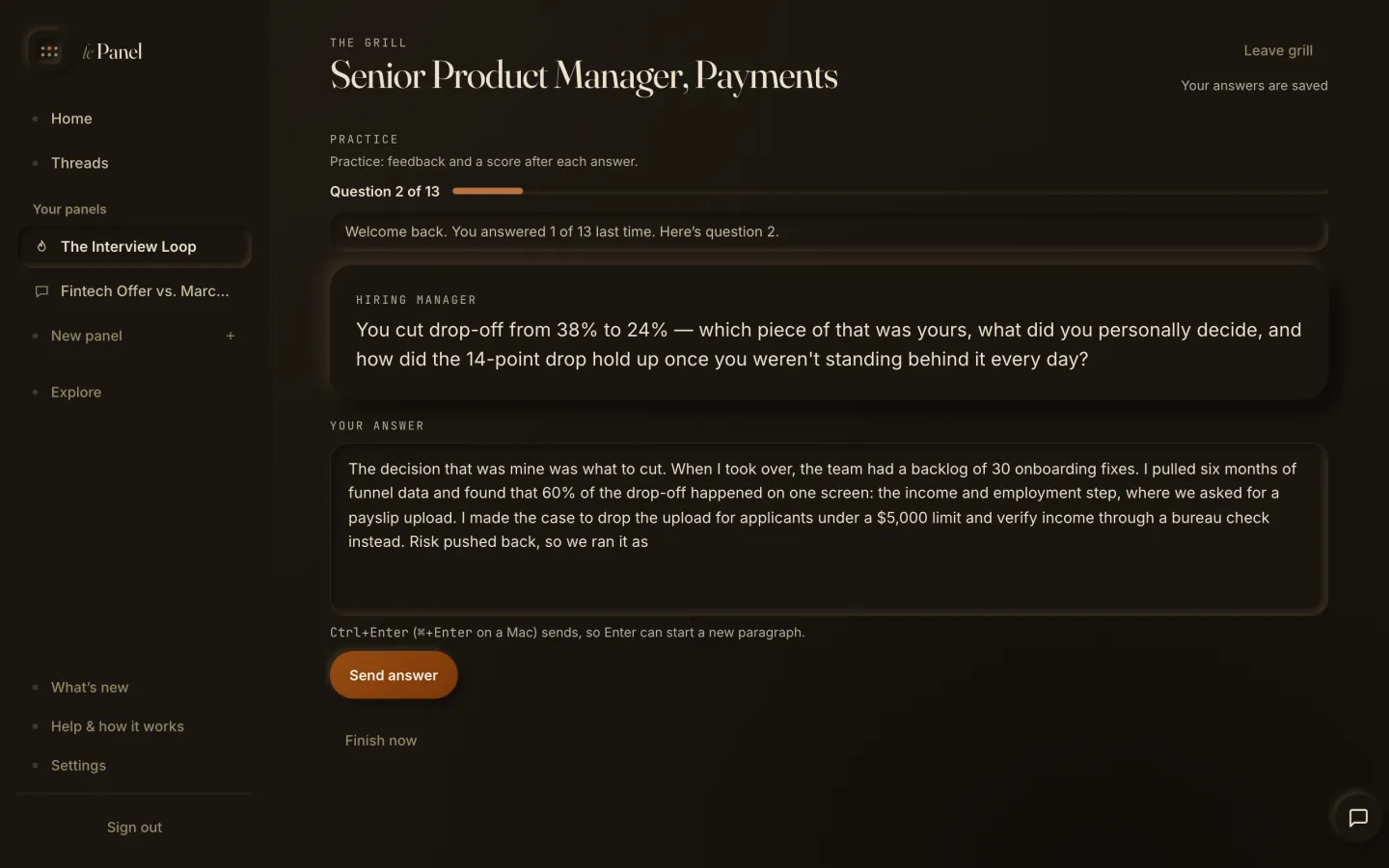
4The asker rotates. The pressure is real.
Each advisor asks in character, grounded in what you attached. You answer in the box; nothing is scored until you submit.
5Every answer scored 0 to 100
A real answer, submitted and scored: the panel critiques it, then the score lands with the per-axis math.
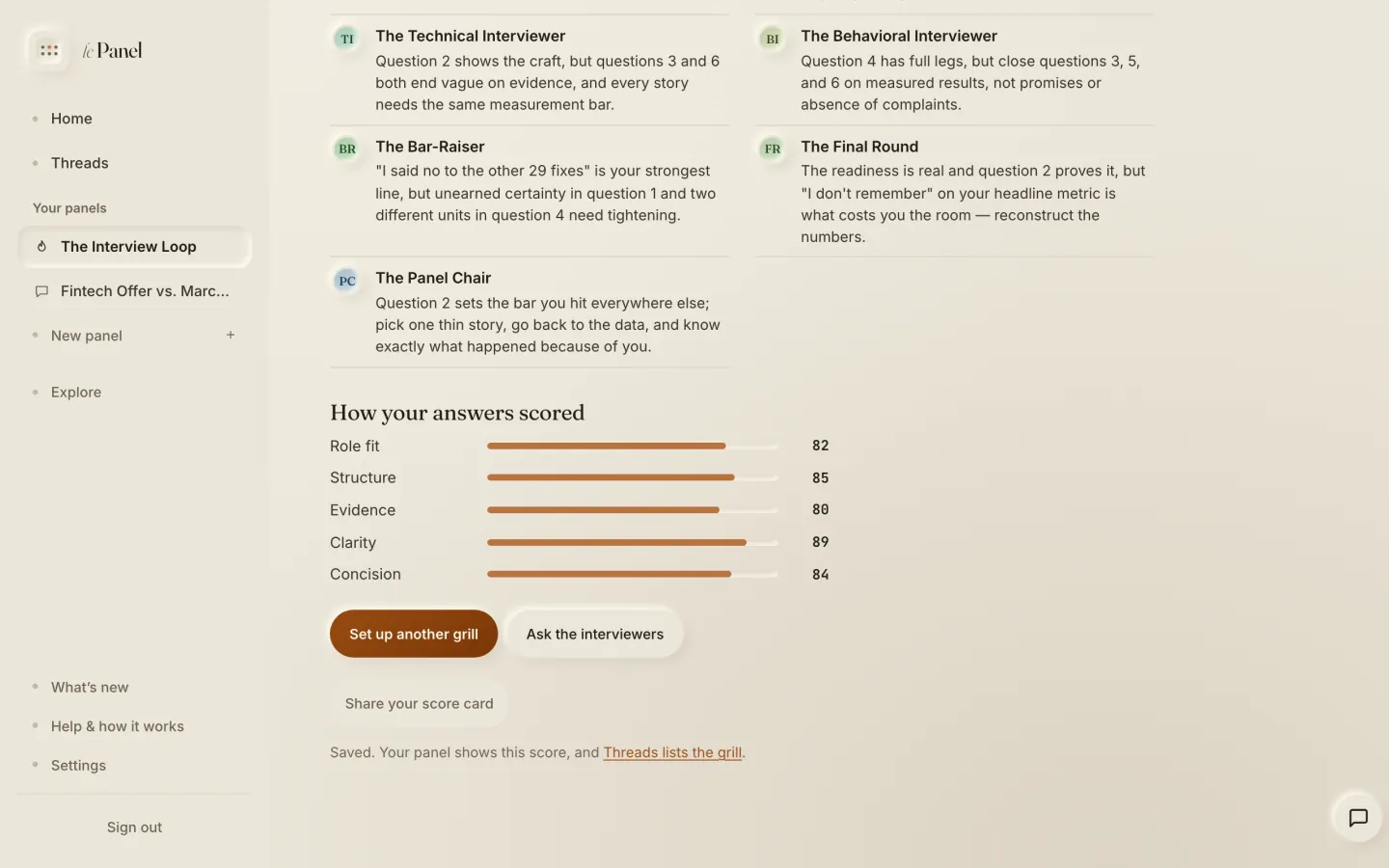
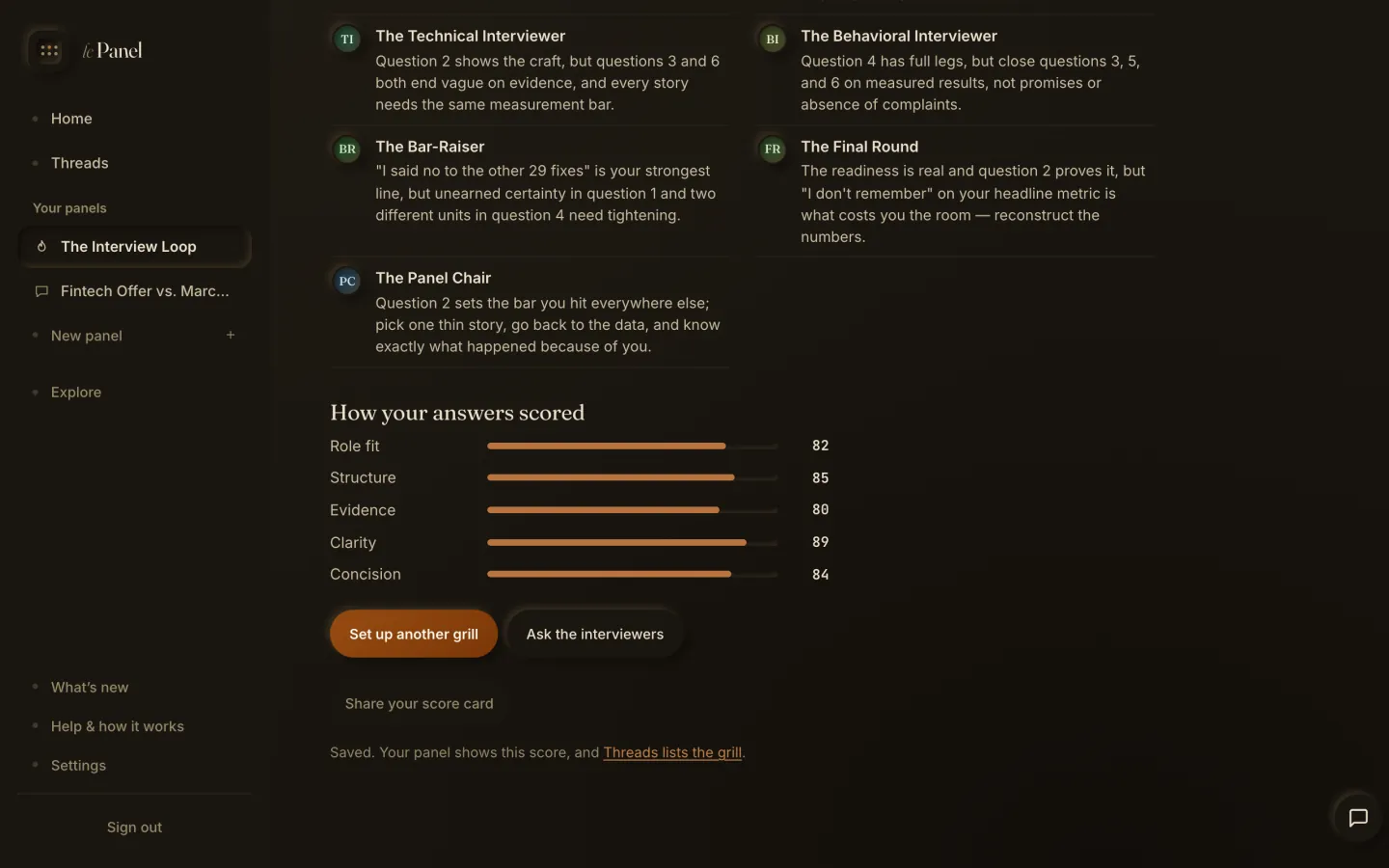
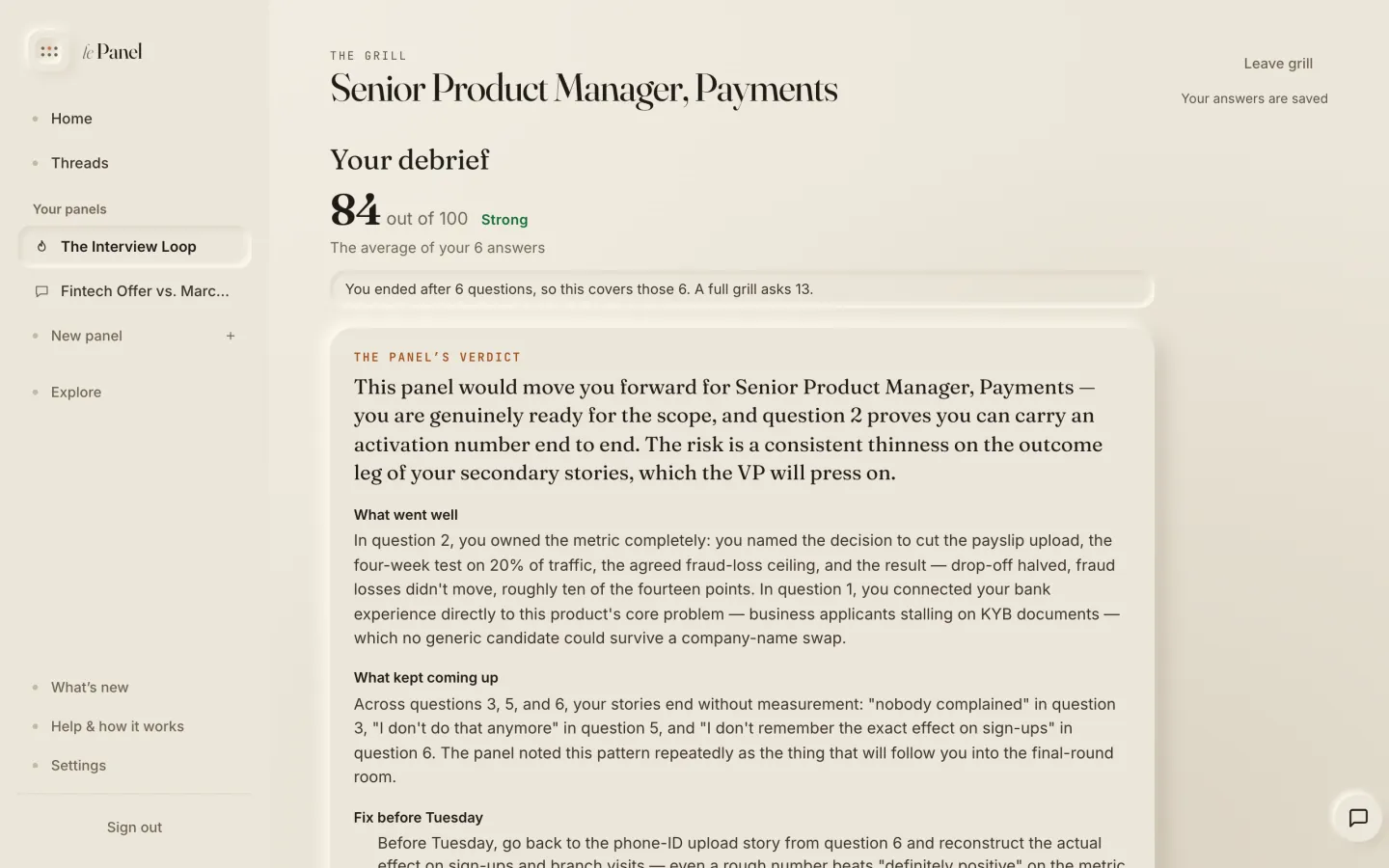
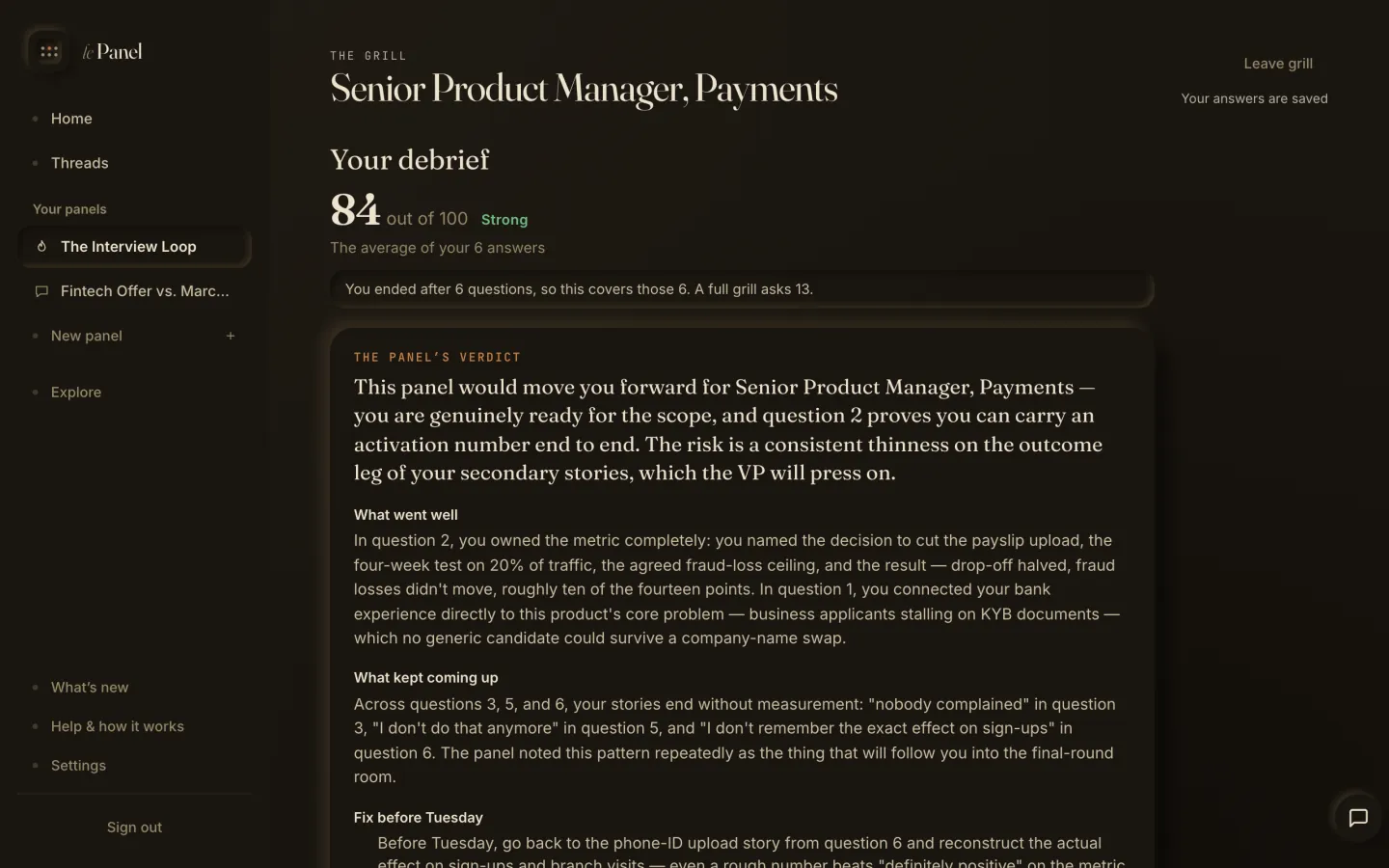
6The debrief
The panel’s debrief, after the last answer.
7The curve, not just the latest grade
Last grill 91 of 100, up since your first. Most improved: concision. Work on: evidence.
1Interview, pitch, board, presentation
Picking the room: interview, pitch, board and presentation grills open.
Two scores, kept honest
One side grades what came back. One grades the question you brought.
Answer score · grades the answers
Built from the marks you leave, panel by panel — with a separate agreement read on every round.
How you ask · grades the question
A separate 0–100, by axis, before the panel replies. Not the answer score. That grades what the panel gave you; this grades how cleanly you framed the call.
A number that just announces “I’m 90% sure” is a feeling in a costume. These reads are structural — your feedback counted over time, agreement measured on every round — and they are never blended into one impressive number, because a weighted average would only hide which leg is weak.
Grounded in your material
Each advisor arrives with an authored stance — how it argues, what it refuses to wave through. Attach your material and the advisor answers from it: the deck, the notes, the transcript. Not a generic guess. Below, an advisor column with its “why” panel already open — the sources the answer drew from:
AR
The Aristotelian
Philosophy
Done
Don't ask which direction. Ask what kind of person each path makes you over ten years.
You're asking which direction; I'd ask a prior question: what kind of person does each path make you over ten years? We become what we repeatedly do, and the promotion is more of the same doing. Ten more years of dreaded Mondays is practice at overriding your own judgment. Neither path is safe. Choose the one whose daily habits you'd be proud to have become.
· Nicomachean Ethics, Book II (notes)
· Becoming by doing: a lecture transcript
One library, every room
Upload a JD, resume, book, PDF, or notes once. Point it at any panel, session, or grill. Reusing a file never costs a second slot. When you’re done, two ways to remove it: take it out of the session, or delete it everywhere at once.
JDResumePDFEPUBDocNotes
Threads that remember
Most AI chats are disposable. lePanel is the opposite: every round stays in its thread, and the panel uses that memory to stop you repeating yourself.
Round 1
“I'm 38. I do alright, but I dread Mondays. Chase the promotion, or leave and build the thing I actually care about?”
Round 2 · same thread, a week later
“The founder sentence is written. What would a 90-day test look like before I resign?”
What's the runway math?Who do I tell first?
We noticed a repeat. This is close to Round 1. Reopen that thread with its full context, or run it again with what’s new.
The words
12 terms the product assumes.
Panel
A small standing group of advisors you put together once and then keep coming back to; the panel is what answers you.
Advisor
One member of your panel: a fully written point of view that answers in its own words, and answers from your material when you attach it.
Round
One question plus everything it produced: each advisor's answer, and the panel's combined read at the end.
Thread
A saved conversation with one panel. A thread holds as many rounds as you want to ask, and it is still there when you come back.
Grill
A practice run where the panel questions you instead of you questioning them, then tells you how it went.
Where the panel landed
The one combined read at the end of a round: what the advisors agree on, where they genuinely split, and what is still your call.
What this panel is for
The scope you give a panel when you create it: the kinds of questions it will take on, and the ones it will turn down.
Ready
Your file has been read and the panel can quote from it. Until then it says Reading, and you can keep working while it does.
Answer score
How useful you have said the panel's answers were, from 0 to 100. It only moves when you mark answers, so it is your rating, not ours.
Question score
How sharp your question was, from 0 to 100. It is a separate number from the answer score, and the one you can actually improve week to week.
Agreement
How much the advisors lined up on the latest question in a thread. High means one shared read; low means they split, often the more useful answer.
Debate
A second pass on a round the panel has already answered: each advisor reads the others' answers and replies once, then the panel's read is rewritten to account for it.
Where your data lives, what it costs, and everything else people ask first: Read the FAQ →